Catalan Institute for Water Research
Research and Innovation for the sustainable use of water
Research and Innovation for the sustainable use of water
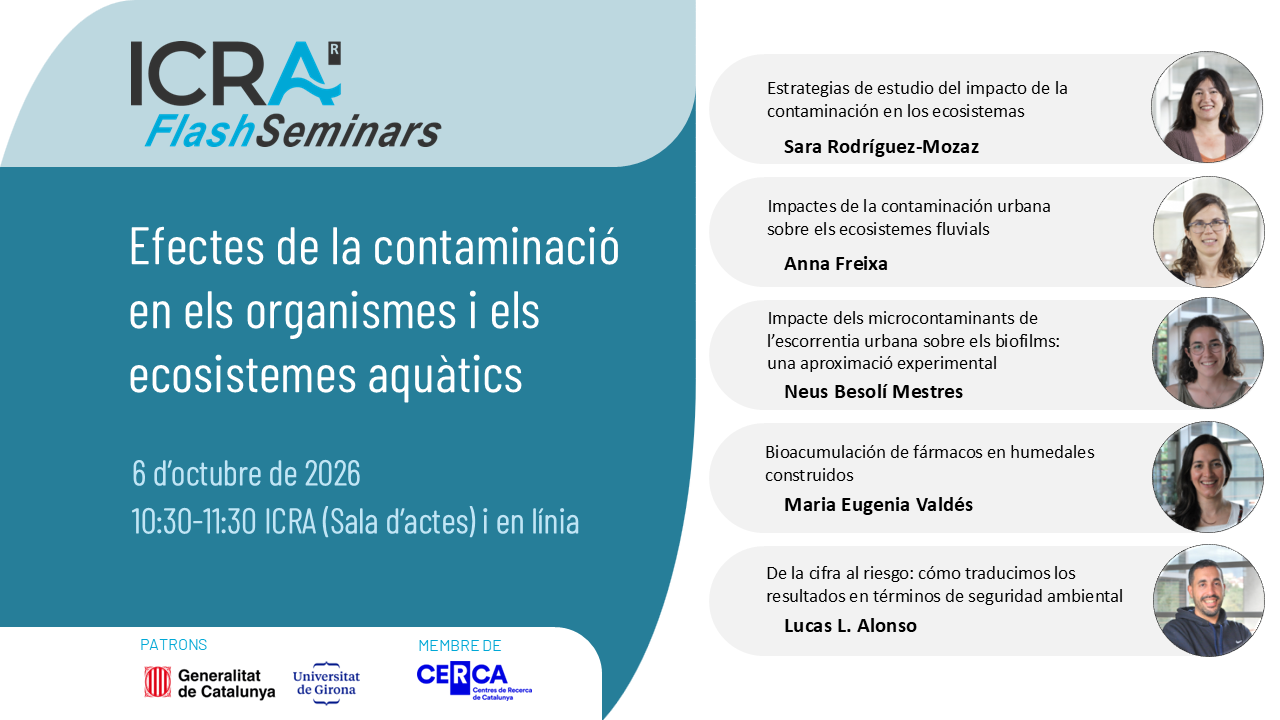
On 6 October, the Catalan Institute for Water Research (ICRA) held a new session of its Flash Seminars, dedicated to the effects of pollution on aquatic organisms and ecosystems. The event, open to the public both in person and online, brought together five researchers from the institute to present different research lines examining how contaminants affect water quality, biodiversity and the functioning of aquatic ecosystems.
The session highlighted that pollution remains one of the main pressures on aquatic ecosystems. Pesticides, pharmaceuticals, PFAS and microplastics are some examples of a wide range of contaminants that can affect both individual organisms and essential ecological communities and processes. In this context, research conducted at ICRA combines field studies, laboratory experiments and risk assessment tools to better understand these impacts and contribute to more effective water resource management.
Researcher Sara Rodríguez-Mozaz opened the session by introducing the issue of pollution in aquatic ecosystems and the different strategies available to study its impacts. Her presentation highlighted the need to integrate different scientific approaches to identify the most relevant contaminants, anticipate potential ecological effects and establish priorities for environmental monitoring and management.
Next, Anna Freixa explained how wastewater treatment plant effluents and stormwater runoff generated during rainfall events can alter water quality and modify aquatic communities responsible for key processes that sustain river ecosystem functioning. She also discussed how ecological research contributes to assessing the health status of river ecosystems and their recovery capacity.
Predoctoral researcher Neus Besolí-Mestres then addressed the effects of micropollutants present in urban runoff on river biofilm communities. Her research examines how these contaminants alter the diversity, structure and ecological functions of these organisms, which are considered highly sensitive indicators of environmental change and are essential for the proper functioning of aquatic ecosystems.
The session continued with a presentation by postdoctoral researcher María Eugenia Valdés, who presented the results of a study on the bioaccumulation of pharmaceuticals in a constructed wetland located in Empuriabrava. This research provides insights into the processes of contaminant transformation and accumulation in organisms and the environment.
Finally, postdoctoral researcher Lucas L. Alonso explained how analytical results obtained from pollution studies can be used to estimate the environmental risk posed by contaminants. He also presented methodologies that help identify priority substances and design more efficient monitoring programmes.